No items in cart
Life Safety
Life safety solutions need to provide swift, single-handed escape, tested and certified operation for complete reliability, and flexibility across different operators, to ensure reliable panic and emergency egress in situations where every moment counts.
Panic and emergency exit devices intended for use on escape route doors are subject to a Construction Products Directive mandate issued by the European Commission and must be type-tested and CE Marked to demonstrate compliance.
These devices have a critical life safety function and must be independently tested by a notified certification body to EN 179 and EN 1125, and be factory production-controlled, before the manufacturer can obtain an EC Certificate of Conformity, declare compliance, and affix the CE Mark to their product.
The main purpose of the performance requirements in EN 179 is to ensure safe and swift escape through a doorway with a single operation of the device, while EN 1125 ensures minimal effort without prior knowledge of the device.
Tindall Engineering offers fully certified solutions for each of these applications in both single- and multi-point locking versions, without sacrificing security performance characteristics. In addition to their life safety certifications, several of our locks have achieved prominent security standards, including LPS 1175* and LPS 1673* for forced entry resistance, NIJ 0108.01 for ballistic resistance, and ISO 16933 for blast resistance.
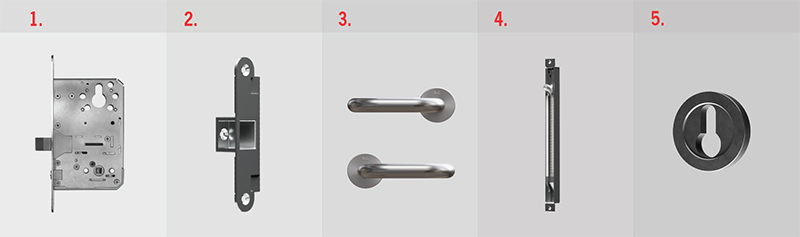
Our locks can be fitted with either an escape lever handle, push pad or panic bar device to provide flexible options for any environment.
To request technical support with safety performance product specification, please contact our Sales Office on 0161 620 0666 or